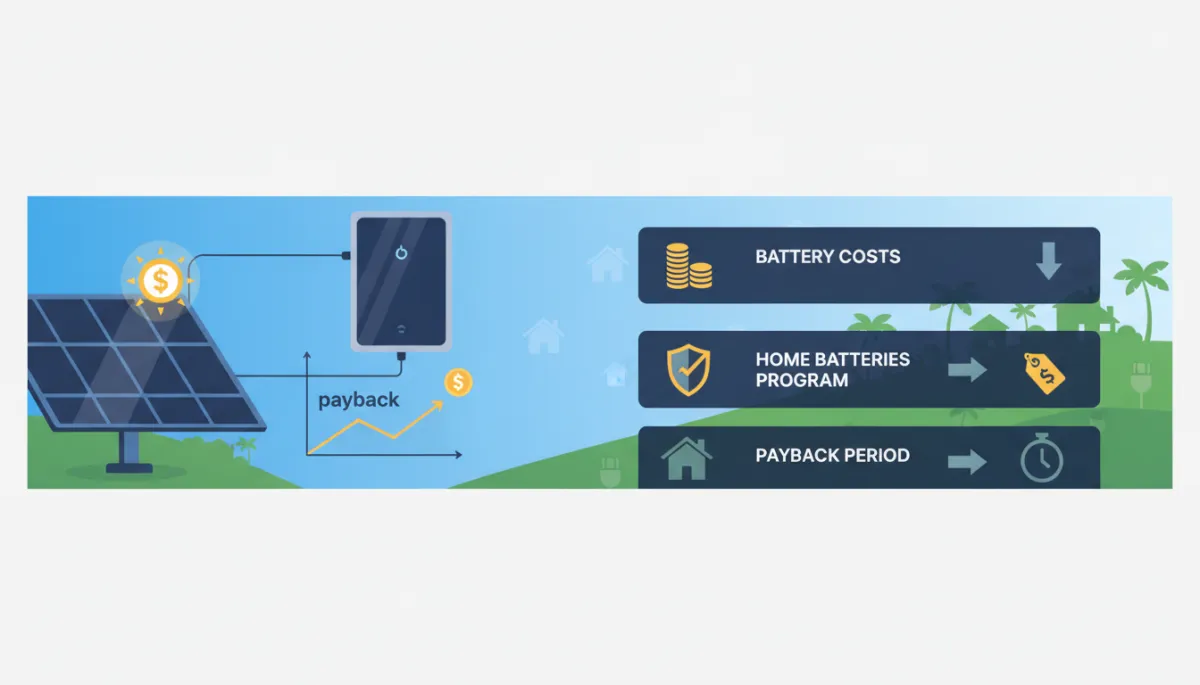
Solar Battery Worth It in SE Queensland? Analysis
Solar Battery, South East Queensland, Payback Period, Battery Costs, Home Batteries Program, Financial Analysis
Is a Solar Battery Worth It in South East Queensland? A Payback Breakdown
If you already have solar – or you’re planning a new system – you’ve probably wondered whether adding a solar battery is actually worth it. In South East Queensland, with falling feed-in tariffs and rising evening electricity rates, the answer is “sometimes yes, sometimes not yet”. This guide from Green Coast Solar & Electrical walks through current battery costs, the new Federal Cheaper Home Batteries Program discount, typical payback periods in SEQ, and the situations where a battery does – and doesn’t – make financial sense.
Current Solar Battery Costs in South East Queensland
Home solar battery prices have come down over the last few years, but they are still a major investment. Across Australia – including South East Queensland – installed solar battery costs in 2026 typically sit between AUD $8,000 and $17,000 for a fully installed system, depending on size and brand (volteam.com.au, solarwise.com.au).
A useful way to think about battery costs is price per usable kilowatt-hour (kWh) of storage. In 2026, most systems land around $600–$1,000 per usable kWh before rebates. That means:
5–6 kWh batteries: Roughly $6,000–$9,000 installed before rebates; about $4,200–$6,300 after the federal discount in many cases (whysolar.com.au).
10 kWh batteries: Around $10,000–$14,000 before rebates; typically $7,000–$10,700 after rebate.
13–15 kWh batteries: Often $13,000–$18,000 before rebates; around $9,000–$13,500 after rebate.
In South East Queensland specifically, a well-sized 10 kWh solar battery typically ends up around $9,000–$12,500 after the federal rebate, depending on the brand and whether any extra electrical work is needed (solarflow.com.au). Premium options like the Tesla Powerwall 3 can still sit at the top end of that range, while quality modular batteries from brands like BYD and Sungrow often sit toward the middle.
How the Federal Cheaper Home Batteries Program Discount Works
A big part of the current financial picture is the Federal Cheaper Home Batteries Program. While program details can evolve, most 2026 analysis assumes a rebate of roughly 30% off the battery component of a residential system, applied as an upfront discount through accredited installers. This is what brings many systems down into that $5,500–$12,000 after-rebate range mentioned earlier.
In practice, here’s what that might look like for a South East Queensland household:
A 10 kWh battery quoted at $12,000 installed before rebate could drop to around $8,400 after a 30% Cheaper Home Batteries Program discount is applied.
A larger 15 kWh battery at $16,000 might fall to roughly $11,200 after the same rebate.
On top of that, Queensland’s Affordable Energy Plan may offer interest-free loans of up to $10,000 for eligible households. This doesn’t reduce the sticker price, but it can save several thousand dollars in interest compared with a standard personal loan, improving the effective payback (solarwise.com.au).
💡 Pro Tip: When you get quotes, ask the installer to show the pre‑rebate price, the Cheaper Home Batteries Program discount, and any state loan options separately. That makes the financial analysis and payback period much clearer.
Typical Solar Battery Payback Periods in South East Queensland
The key question for most homeowners is the payback period – how long it takes for bill savings and any extra income streams to cover the cost of the battery. For South East Queensland, recent guides show a wide range depending on your tariff and usage patterns:
Typical SEQ household on a flat tariff: 12–18 years payback for a 10–13.5 kWh battery, based on annual savings of around $900–$1,200 (solarwise.com.au).
Households on time‑of‑use tariffs (with peak rates near 40c/kWh): Often 8–12 years payback, because you’re offsetting more expensive evening power (whysolar.com.au).
Optimised setups – high evening usage, good solar size, maybe a Virtual Power Plant (VPP): 5–9 years in the best cases (sourceenergygroup.com.au).
Australia‑wide, most sources now quote 6–12 years as a realistic payback range for solar plus battery where conditions are favourable (dailyenergynews.com.au, househonest.com.au). South East Queensland generally sits in the middle of that pack – not the very fastest payback state, but often better than areas with lower electricity prices.
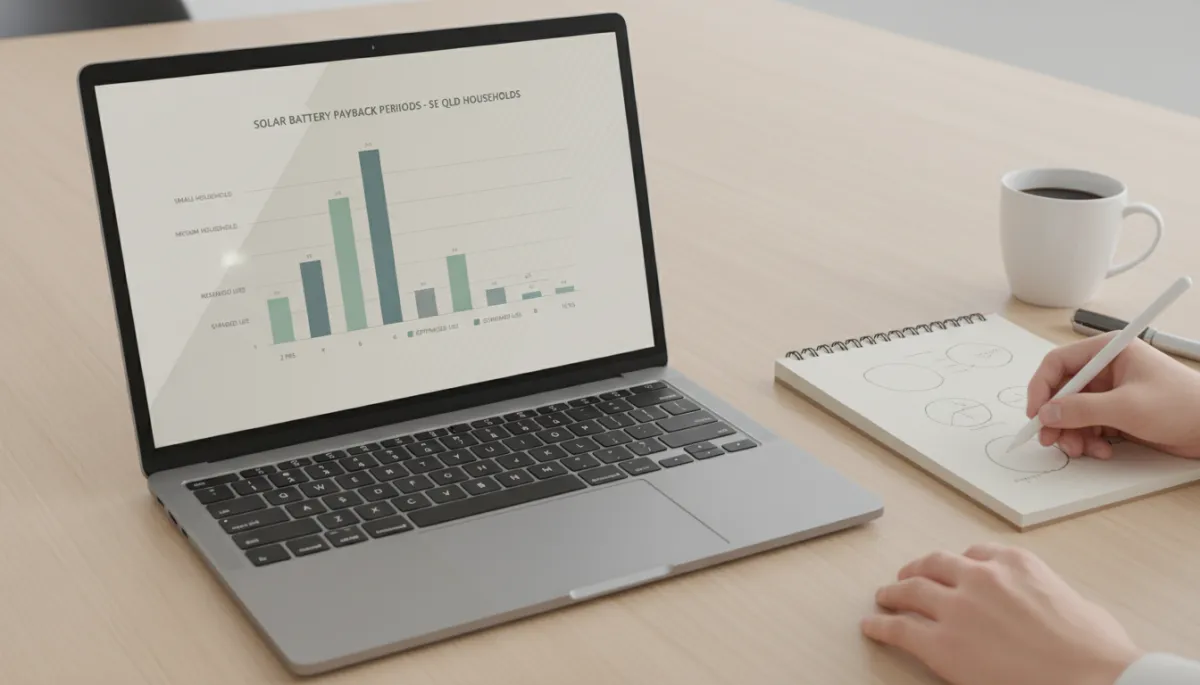
Tailored payback modelling shows some SEQ homes recover battery costs in under ten years.
When a Solar Battery Makes Financial Sense in SEQ
A solar battery can be a smart financial move in South East Queensland, but only when the numbers line up with your lifestyle. From our experience at Green Coast Solar & Electrical, a battery is more likely to stack up when several of the following are true:
You use a lot of power in the evenings and at night. If your household is busy from 4pm–10pm – cooking, running air‑conditioning, doing laundry – you can shift more of that usage from grid power to stored solar. That increases your savings and shortens the payback period.
You’re on a time‑of‑use or demand tariff. With high peak rates and cheaper off‑peak power, a battery lets you avoid the most expensive grid energy. Some households also use batteries for limited “peak shaving” of demand charges, which can add to the financial benefit.
You have a well‑sized solar system already. A battery only has something to store if your solar is producing more than you’re using during the day. In SEQ, a 6.6–10 kW PV system is common for homes aiming to support a 10–13 kWh solar battery.
You can access the Cheaper Home Batteries Program and low‑cost finance. That 30% federal discount plus an interest‑free state loan (if you’re eligible) can move a marginal payback into clearly positive territory over the 10‑year warranty period of most batteries.
You value backup power and resilience. While harder to put a dollar figure on, avoiding food spoilage, keeping medical equipment running, or maintaining comfort during storms and outages is worth real money for many families in coastal SEQ.
📌 Key Takeaway: The best candidates for a solar battery in South East Queensland are households with high evening usage, a solid solar system, and access to current rebates and finance – not just anyone with panels on the roof.
When a Solar Battery Doesn’t Add Up (Yet)
Honesty is one of our core values at Green Coast Solar & Electrical, and the truth is that for some SEQ homes, a solar battery is still more of a “nice to have” than a financially compelling investment. A battery may not make strong financial sense if:
Your daytime usage is high and your export is low. If you already self‑consume most of your solar, there’s not much surplus to charge a battery. In that case, upgrades like energy efficiency, better load‑shifting, or even an EV charger might give better returns.
You’re on a low flat tariff with modest bills. If your total bill is already quite low (for example, under $200 per quarter), the absolute savings a battery can deliver may not justify a $8,000–$12,000 outlay, even after the Home Batteries Program discount.
You plan to move within 5–7 years. Most payback calculations assume you’ll stay in the home at least 8–10 years. If you’re likely to sell sooner, you may not see the full benefit, even though a battery can be attractive to buyers.
Your priority is the fastest possible financial return. In many cases, adding extra solar panels still beats a battery on pure payback period. Solar alone often pays back in 3–6 years, while adding a battery pushes that to 6–12+ years for the combined system (dailyenergynews.com.au).
Making a Smart, Personal Decision for Your SEQ Home
Ultimately, whether a solar battery is “worth it” in South East Queensland comes down to your numbers and priorities. The technology is mature, and with the Federal Cheaper Home Batteries Program, battery costs are more accessible than they’ve ever been. But a good decision still depends on careful financial analysis of your usage, tariffs, and goals.
At Green Coast Solar & Electrical, our engineering‑led approach means we don’t just bolt a battery on and hope for the best. We:
Analyse your historical energy data (where available) to model realistic battery behaviour in a South East Queensland climate.
Compare different battery sizes and brands against your evening and overnight usage to find the true “sweet spot”.
Show you side‑by‑side scenarios: solar only, solar plus battery now, or solar now with battery‑ready hardware and a staged upgrade later.
💬 Honest advice, no pressure: Sometimes our recommendation is not to install a battery yet – and we’re comfortable saying that. Our focus is long‑term reliability and value, not quick sales.
Ready to Explore Your Own Payback Period?
If you live in Brisbane, the Gold Coast, Sunshine Coast or Northern NSW and you’re considering a solar battery, the best next step is a tailored financial analysis for your home. With current battery costs, the Federal Cheaper Home Batteries Program discount, and local tariffs in South East Queensland, the numbers are changing quickly – and they won’t be the same for every household.
Green Coast Solar & Electrical offers free, no‑pressure consultations where you can speak directly with a local solar expert. We’ll walk through your bills, usage patterns and goals, then provide a clear, written payback breakdown so you can decide with confidence whether a solar battery is worth it for you – now, later, or not at all.
Book a free, no‑pressure consultation today to find out how a properly designed solar and battery system could work for your South East Queensland home – and whether the payback period fits your plans for the next decade.
